Showing posts with label # STARR Kay. Show all posts

Kay STARR 1975


A solid jazz singer whose early recordings tended to be forgotten after her ascendancy into the commercial sphere during the mid-'50s, Kay Starr was among the first pop singer to capitalize on the "rock fad" with her 1955 novelty "Rock and Roll Waltz." Her biggest hit came with the era-defining "Wheel of Fortune," a prime slice of '50s adult pop with a suitably brassy reading. Born in Oklahoma, she moved to Dallas at a young age and made her debut on radio while still in school. A brief stay with Glenn Miller & His Orchestra precipitated her working with groups led by Bob Crosby, Joe Venuti and finally Charlie Barnet. She recorded a few numbers with Barnet that earned her a solo contract with Capitol.

By 1948, Starr made her Your Hit Parade breakthrough with "You Were Only Foolin' (While I Was Falling in Love)." Subsequent hits like "Hoop-Dee-Doo," "Oh, Babe!" and "I'll Never Be Free" (the latter with Tennessee Ernie Ford) framed her in an emerging vein of the popular market that also looked back to traditional country and folk. In 1952, "Wheel of Fortune" became her biggest hit and one of the signature songs of the '50s pop sound. She struggled to reach a similar chart peak for several years afterwards, though "Comes A-Long A-Love" topped the British charts. With her move to RCA in 1955, though the comical "Rock and Roll Waltz" spent several weeks at number one. It was her last major hit, followed by just one additional Top Ten entry, 1957's "My Heart Reminds Me." By the 1960s, she had begun to concentrate more on performing (especially in Las Vegas) than recording, despite moving back to Capitol in 1961. In the '90s, she played several oldies packages, including the 3 Girls 3 tour with Helen O'Connell and Margaret Whiting.

Kay STARR 1955

Kay STARR 1955

STARR Kay 1940's

Kay Starr was born in 1922 in Dougherty, Oklahoma as Katherine LaVerne Starks. Her father was a full blooded Native American and many biographies state that she was born on a Federal Reservation. At a young age the family moved to Dallas, Texas. Some members of her family thought that she had a world of talent for singing and had her enter a local amateur talent competition in the local Dallas area. She was so good that after winning the contest for a number of weeks she had her own local radio program. Soon after the family moved again, this time to Memphis, Tennessee.
Katherine Starks soon had another radio program and also was in the regular cast on WREC's Saturday Night Jamboree one of the Mid-South's top rated programs during the depression years. In 1937 when she had changed her name shortened to Kay Starr, she got a break when band leader Joe Venuti was appearing at the Peabody Hotel (famous for its daily "duck walk"). He signed her as the female vocalist with the band, school permitting (she was after all, fifteen years old). After two years of part time vocalizing with Venuti, she went to New York and appeared briefly with Bob Crosby and also had a brief stint with the Glenn Miller Orchestra. It was with Miller that Starr made her very first recording "Baby Me" (which she sang on the radio broadcast on July 24th) and "Love With A Capitol YOU" on Bluebird .

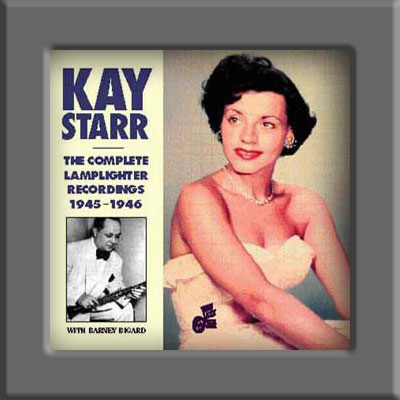
Starr returned to Memphis, and after high school graduation she moved to California and rejoined Joe Venuti. That association lasted until World War II caused the band to break up. By 1943 she was with the band of Charlie Barnet and recorded some sides for Decca especially "Sharecroppin' Blues". A bout of pneumonia curtailed her career for a number of months in 1945 into 1946. She recorded a few sides for independent labels until in 1947 Starr was signed to Capitol Records, a rapidly developing major record company. Now Starr moved from mainly jazz singing to a more pop oriented sound that soon began to pay dividends in making Kay Starr one of music's top recording stars. In late 1948 Starr made the best sellers hit parade for the first time. The song was "You Were Only Fooling" on Capitol. The follow up side for Capitol "So Tired" was a top ten seller and remained on the best sellers for four month. In the spring of 1949 "How It Lies, How It Lies" briefly made the hit parade. Starr returned to the best sellers one year later in May of 1950 with two huge hits in a row. "Hoop-De-Doo" was a cover of the original by Perry Como for RCA, but enough record buyers and radio listeners liked Starr's version to get it to number two in the country and was a four month chart topper. She followed that up with "Bonaparte's Retreat" with the band of Lou Busch. The record had staying power as it remained on the top sellers list for an incredible seven months and made Kay Starr one of post war pop music's big names.
A brief hit side of the tune "M-I-S-S-I-S-S-I-P-P-I" was followed as Capitol put Starr in the recording studio with country star Tennessee Ernie Ford. In the late summer of 1950 the record on Capitol provided a two sided hit. "Ain't Nobody's Business But My Own" was a top twenty seller but the flip side "I'll Never Be Free" was a huge hit topping out at number three and staying on the list for five months. Kay had one last chart hit during the year with her cover of "Oh Babe" originated by Louis Prima. 1950 was quite a year for Starr.
She began 1951 with another pairing with Ernie Ford. The songs were "Oceans Of Tears" and "You're My Sugar" released on Capitol. Both songs made the top sellers list with "Oceans". In mid simmer Starr recorded a cover of Rosemary Clooney's hit "Come On-A My House". Her last charter of the year was "Angry", recorded with the band of Dave Cavanaugh.
Eddie Wilcox and his band with vocal by Sunny Gale had recorded "Wheel Of Fortune" for Derby and it began to sell big. The the R & B vocal group The Cardinals recorded the tune for Atlantic and it started to sell big. Capitol hurriedly set up the studio in January of 1952 for Kay Starr to record her version of the song, and it was quickly released on. Starr's version completely eclipsed all other versions of the tune and dominated the pop market like few records had in the post war years. "Wheel" sold over one million, held the number one position in the country for an unbelievable two and a half months, and remained on the best seller charts for more than six months. This incredible performance made Starr among the biggest entertainers in the world. Starr had six other chart tunes during the year, but her version of "Wheel" overshadowed them all. "I Waited A Little Too Long" was a top twenty seller, "Kay's Lament" and "Fool, Fool, Fool" (originally by the great R & B vocal group The Clovers for Atlantic) was a two sided hit with both getting into the top twenty, and "Three Letters" and "Comes Along A-Love" also charted both sides. "Comes Along A-Love" was a strong seller topping the charts at number nine in the country. It was quite a year !
In 1953 Kay Starr started out the year without seemingly missing a beat. Her first record of the year was "Side By Side" on Capitol. It was another huge hit for Starr. In June a solid two sided hit record followed featuring the songs "Half A Photograph" and "Allez-Vous-En" a tune from the Broadway hit show "Can Can" released. Later in the year Starr recorded the pop music oldie "When My Dreamboat Comes Home" and "Swamp Fire" with Dave Cavanaugh's Orchestra. She closed out the year with "Changing Partners" a hit on Decca for Bing Crosby. Starr's version of the song did well however, becoming a solid top ten seller well into 1954.
In the spring of 1954 Kay Starr once again recorded a two sided smash for Capitol Records. "If You Love Me, (Really Love Me)" and "The Man Upstairs" with the orchestra of Harold Mooney. In September Starr did it again, registering two top sellers on Capitol "Am I A Toy Or A Treasure" and "Fortune In Dreams". In less than six years Kay Starr had twenty nine best selling records for Capitol making her one of the most successful recording artists of the post war decade. And it was not over yet.

In 1955 Kay Starr moved to RCA Victor Records after all those years at Capitol. She had one brief hit for them in 1955 with "Good And Lonesome" on RCA. Starr appeared in two television specials "Promenade" in 1955, and "The Lord Don't Play Favorites" in 1956. The rock 'n roll age was upon the country in 1956 and pop music performers were dropping by the wayside as teenagers took over the record industry's reliance on the 78 and now 45 rpm single. In early 1956 Starr did the impossible by recording a song that appealed to both the teens and their parents. The song was "Rock And Roll Waltz". The record was a number one hit and a million seller, her second gold record. She had a brief hit with "Second Fiddle", and then closed out the year with her last charted single "My Heart Reminds Me".
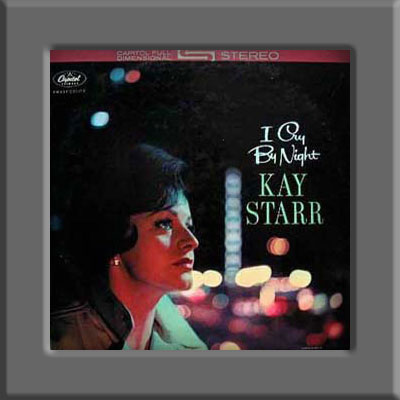
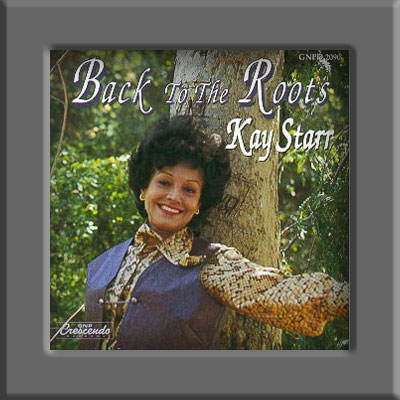
By 1957 it was apparent that kay Starr's future in music lay in a more sophisticated style geared toward adults and presented in the new LP format. Leave rock 'n roll to the kids she thought and RCA agreed . In 1957 Starr appeared in a movie version of "The Pied Piper Of Hamelin" with Van Johnson, Jim Backus, and Claude Rains. In 1959 however she left RCA and returned to Capitol and during the nineteen sixties concentrated mostly on her jazz stylings that she had first exhibited in the mid forties. In the early sixties she recorded the LP albums "Movin" with Van Alexander, "I Cry By Night", and a country music album called "Just Plain Country". During the mid sixties Starr performed on television on "Hollywood palace" a number of times, and also made multiple guest shots on The Dean Martin Show. In 1968 she recorded an album with the Count Basie band for ABC Paramount called "How About This". Another Starr-Basie collaboration was "Encounter" on MCA. In the mid seventies Starr recorded a LP called "Back To The Roots" for GNP Crescendo with an all star small jazz combo with Red Norvo, Blue Mitchell, Georgie Auld, and Jimmy Rowles. From that point on Starr cut back on in person appearances and recording. But the memories remain as Starr has left a legacy of great music to be enjoyed for many many years to come.

SELECTION OF THE 1940's (17 tracks)

Kay Starr at her best in jazz singing. Don't miss this wonder...